RSS

New property listed in Castlegar

I have listed a new property at 2436 11th Avenue in Castlegar. See details here

Tucked away at the end of a quiet no-through road on the desirable Kinnaird Bench, this beautifully updated home offers exceptional privacy, versatility, and comfort. The three-bedroom main floor is open and bright. The lower level features a beautifully finished legal one-bedroom suite, providing an excellent mortgage helper or space for extended family. Outside, the backyard is a true retreat, with mature trees, and a private patio that's perfect for relaxing or entertaining. Enjoy the tranquility of this secluded setting while still being just a short walk to Kinnaird Elementary School, Kinnaird Park, and nearby amenities. Whether you're looking for a family home with income potential or a quiet place to enjoy the outdoors, this property offers the perfect combination of location, privacy, and flexibility. (id:2493)

Read

From Offer to Possession

Understanding the Key Dates in a B.C. Contract of Purchase and Sale

While the purchase price often gets the most attention, the various dates contained within the contract are equally important because they establish the timeline for the transaction and outline the responsibilities of both the buyer and seller.

Understanding what these dates mean can help reduce confusion and ensure a smoother transaction.

Date of Offer

The date of the offer is simply the day the buyer signs and submits their offer to purchase the property. This date establishes when the offer was made. In British Columbia, a verbal offer is not binding in a real estate transaction.

For an offer to be valid and enforceable, it must be made in writing.

Offer Open for Acceptance

Every offer includes a deadline by which the seller must respond. This is date and time that an "Offer Open for Acceptance". If the seller accepts the offer before this deadline and the acceptance is properly communicated, a contract is formed. If the deadline passes without acceptance, the offer expires automatically.

This deadline helps ensure that buyers are not left waiting indefinitely for a response.

Acceptance Date

The acceptance date is the date on which the seller accepts the buyer's offer and the acceptance is communicated to the buyer or the buyer's representative. Once acceptance has occurred, a legally binding contract is generally created, subject to any conditions contained within the agreement and any applicable statutory rights, such as the Home Buyer Rescission Period.

Buyer's Right of Rescission

In British Columbia, most residential home purchases are subject to the Home Buyer Rescission Period (HBRP), sometimes referred to as the "cooling-off period." The HBRP generally gives a buyer the right to cancel an accepted offer within three business days following acceptance of the contract. If a buyer exercises this right, they must pay the seller a rescission fee equal to 0.25% of the purchase price. 

Not all transactions are subject to the HBRP, and there are exemptions established by legislation. Buyers should seek professional advice if they are unsure whether the rescission period applies to their purchase.

Deposit Date

The deposit is a sum of money provided by the buyer as specified in the contract. The contract will identify both the amount of the deposit and the deadline by which it must be delivered. Deposits are typically held in trust by the brokerage unless otherwise specified.

The deposit forms part of the purchase price upon completion of the sale. If a transaction fails to complete, the handling of the deposit will depend on the terms of the contract and any agreement between the parties or legal determination.

Subject Removal Date

Many offers contain conditions, commonly known as "subjects," that must be satisfied or waived before the transaction becomes firm.

Common subjects may include:

  • Financing approval

  • Property inspection

  • Review of title or disclosure documents

  • Sale of the buyer's existing property

The subject removal date is the deadline by which the buyer must either remove or waive these conditions in writing. If the subjects are not removed by the specified deadline, the contract may come to an end unless the parties agree otherwise.

Completion Date

The completion date is the day legal ownership of the property transfers from the seller to the buyer.

On this date:

  • The buyer's lawyer or notary transfers the purchase funds.

  • Transfer documents are registered with the provincial land title system.

  • The seller receives the sale proceeds after adjustments and closing costs.

Completion usually occurs during regular business hours and is often not the same day that the buyer receives the keys.

Adjustment Date

The adjustment date is the date used to calculate financial adjustments between the buyer and seller.

These adjustments may include:

  • Property taxes

  • Utility charges (where applicable)

  • Rental income deposits

  • Other prepaid or outstanding expenses related to the property

The goal is to ensure that each party pays only their fair share of expenses for the period during which they own the property. In most residential transactions, the adjustment date is the same as the completion date, although it can differ if the parties agree.

Possession Date

The possession date is the day the buyer receives the right to occupy the property and typically receives the keys.

Possession often occurs the day after completion, although the parties may agree to a different arrangement.

Buyers should avoid scheduling movers, contractors, or other services until possession has been confirmed through their lawyer, notary, or real estate professional.

Property Viewed Date

The contract includes a section where the buyer indicates the date on which they viewed the property.

This date records when the buyer physically viewed the property or acknowledges that the property may not have been viewed before the offer was made. The property viewed section helps document the circumstances surrounding the purchase and forms part of the contract record.

An important provision connected to this section states that the property and all included items will be in substantially the same condition on the Possession Date as when viewed by the buyer, subject to reasonable wear and tear and any changes agreed to by the parties in writing.

This provision helps establish the expectation that the buyer will receive the property in essentially the same condition as it was when they decided to purchase it. For this reason, buyers will often conduct a final walk-through before completion or possession to confirm the property's condition and verify that any agreed-upon inclusions remain in place.

Why These Dates Matter

Every date in a Contract of Purchase and Sale serves a specific purpose. Missing a deadline can have significant consequences, including the loss of contractual rights, delays in closing, or even the termination of a transaction.

Whether you're buying your first home or selling a property you've owned for years, understanding the timeline established by the contract can help you make informed decisions and avoid unnecessary surprises.

Final Thoughts

A Contract of Purchase and Sale is more than just a purchase price and a signature. It is a detailed roadmap that guides the transaction from the initial offer through to possession of the property.

If you are buying or selling real estate in British Columbia, take the time to review each date carefully and ensure you understand its purpose. When questions arise, seek advice from qualified professionals, including your real estate licensee, lawyer, or notary, so that you can proceed with confidence.

This article is intended for general information only and is not legal advice. Real estate transactions can vary, and readers should seek professional advice regarding their specific circumstances.

Read

Sales Struggle Against a Weak Economy and Rising Mortgage Rates

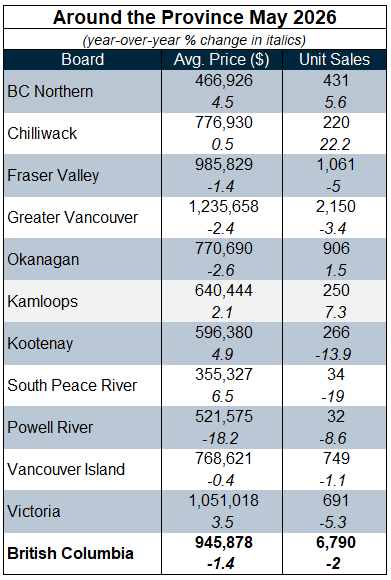
The British Columbia Real Estate Association (BCREA) reports that 6,790 residential unit sales were recorded in Multiple Listing Service® (MLS®) Systems in May 2026, down 2 per cent from May 2025. The average MLS® residential price in BC in May 2026 was down 1.4 per cent at $945,878 compared to $959,216 in May 2025.

Total MLS® residential sales dollar volume was $6.42 billion, down 3.4 per cent from the same time the previous year. BC MLS® unit sales were 26.39 per cent lower than the ten-year average for the month of May.

“Rising mortgage rates and a weak labour market continue to constrain activity around the province but especially in the Lower Mainland,” said BCREA Chief Economist Brendon Ogmundson. “The recent rise in mortgage rates presents an unexpected headwind for the market this year and may further delay a recovery in activity.”

Year-to-date, BC residential sales dollar volume is down 8 per cent to $25.1 billion, compared with the same period in 2025. Residential unit sales are down 6.9 per cent year-over-year at 26,681 units, while the average MLS® residential price is also down 1.2 per cent to $941,883.

Copyright British Columbia Real Estate Association. Reprinted with permission.

Read

New property listed in Nelson

I have listed a new property at 4638 6 Highway in Nelson. See details here

Selkirk Mountain Retreat – Home, Business & Lifestyle Opportunity Welcome to a truly exceptional property where adventure, nature, and opportunity come together. Located adjacent to the Nordic Ski Club trails and at the turnoff to Whitewater Ski Resort, this unique acreage places year-round recreation right outside your door. Zoned C2 Tourist Commercial, the property offers outstanding potential for entrepreneurs, investors, or families seeking a mountain lifestyle with income opportunities. The beautifully updated home features five spacious bedrooms and was designed with hospitality in mind, making it ideal as a lodge, inn, retreat, or guest accommodation business. Previously operated as a farm, the acreage consists primarily of open pastureland surrounded by the spectacular beauty of the Selkirk Mountains. Deer, elk, birds, and other wildlife are frequent visitors, creating a peaceful and inspiring setting. Two cabin sites are already prepared for development, providing excellent potential to expand accommodations and generate additional revenue. Whether you envision a boutique lodge, wellness retreat, tourism business, hobby farm, or family estate, the possibilities are extensive. Rarely does a property combine commercial zoning, income potential, acreage, and direct access to some of the Kootenays' finest outdoor recreation. A remarkable opportunity in the heart of the Selkirks. (id:2493)

Read

Wildfire Season and Real Estate: Why Insurance Can Make or Break a Deal

When most people think about wildfires, they think about damaged homes, smoky skies, and evacuation alerts. What many buyers and sellers don't realize is that wildfires can also disrupt real estate transactions long before a property is ever threatened by flames.

In British Columbia, wildfire risk has become more than a property concern—it's now a transaction concern. During wildfire season, a buyer's ability to obtain home insurance can directly impact whether a sale closes on time, gets delayed, or falls apart altogether.

The Growing Connection Between Wildfires and Real Estate

In recent years, insurers have become increasingly cautious about issuing new policies on properties located near active or out-of-control wildfires. Depending on the insurer and the situation, restrictions may apply to homes located anywhere from 25 to 100 kilometers from an active fire, particularly if the property falls within an evacuation alert or evacuation order area.

Even when a home itself is not in immediate danger, insurers may temporarily suspend new coverage until wildfire conditions improve. This creates a challenge for buyers who are approaching their completion date.

Why Insurance Matters So Much

For most buyers, obtaining home insurance isn't just a recommendation—it's a requirement.

Mortgage lenders typically require proof of insurance before they will release mortgage funds. Without a valid, active policy in place, financing may not be advanced, regardless of how close the transaction is to completion.

One of the biggest misconceptions buyers encounter is the difference between an insurance quote and a bound policy. A quote simply indicates that coverage may be available. A bound policy means the insurer has officially committed to providing coverage.

During wildfire season, that distinction becomes critical. A buyer who receives a quote weeks before closing may discover that coverage can no longer be bound if wildfire conditions change before the completion date.

What Buyers Should Do

The best strategy is to start the insurance process as soon as an offer is accepted.

Rather than waiting until the final days before completion, buyers should speak with their insurance provider early and ask important questions such as:

  • Can the policy be bound immediately? when can it be bound?

  • Are there wildfire-related restrictions for this property?

  • How close can an active wildfire be before coverage is affected?

  • Does the property's fire protection status influence eligibility?

  • What happens if wildfire conditions change before closing?

Having these conversations early can help identify potential issues while there is still time to address them.

What Sellers Should Do

Sellers also need to be mindful of wildfire-related insurance risks.

It's important to maintain existing insurance coverage until the transaction has fully completed and ownership has officially transferred. If a deal falls apart because a buyer cannot obtain insurance, a seller who has already cancelled their policy could find themselves unexpectedly uninsured during wildfire season.

In some circumstances, obtaining new coverage after cancelling an existing policy may be difficult if wildfire activity has increased in the area.

Keeping insurance in place until the deal is complete is one of the simplest ways sellers can protect themselves and their property.

Contract Clauses Can Help

Recognizing the growing impact of wildfire-related insurance issues, the real estate industry has developed optional contract language designed to address these situations.

A wildfire-related clause can provide additional time for completion, adjustments, and possession if a buyer is temporarily unable to obtain insurance because of wildfire conditions. Rather than forcing a deal to collapse, the clause can allow both parties additional time for conditions to stabilize and insurance coverage to be secured.

These provisions can be particularly valuable for rural properties, homes near forest interface areas, and communities where wildfire conditions can change rapidly.

The Bottom Line

Wildfire season has added a new layer of complexity to real estate transactions across British Columbia. Today, insurance availability can influence whether a lender funds a mortgage, whether a buyer can complete a purchase, and whether a seller remains protected throughout the transaction.

The key is preparation.

Buyers should obtain insurance quotes early and understand exactly when coverage can be bound. Sellers should maintain their existing coverage until the transaction is fully complete. And both parties should consider whether contract language addressing wildfire-related delays makes sense for their situation.

In today's market, wildfire risk isn't just something homeowners need to think about after they own a property—it has become an important part of getting the deal across the finish line in the first place.

Read

Bank of Canada Interest Rate Announcement

The Bank of Canada maintained its overnight policy rate at 2.25 per cent this morning. In the statement accompanying the decision, the Bank noted a dampening of economic conditions since its most recent projections in April, citing weakness in government spending, housing activity, and business investment, accompanied by rebuilding inventories and (somewhat) anomalous increases in imports. However, the Bank expects growth to resume in the second quarter, albeit at a relatively weak pace. As the Iran conflict enters its fourth month, CPI inflation rose to 2.8 per cent in April, largely aligning with the Bank’s expectations as the oil price shock places severe pressure on energy prices. However, the Bank has found limited evidence of broad pass-through of higher oil prices into other products, as core inflation remains around 2 per cent, which is a leading factor in the Bank’s policy response to the conflict. Taken together, inflation is still expected to remain around 3 per cent before moderating towards 2 per cent over time. As a result, the Bank is continuing to look through the short-term impact of the conflict on headline inflation, but stands ready to adjust its policy rate if there are signs of persistence and transmission into the prices of other goods.

Weaknesses in the Canadian economy and labour market paired with inflationary pressure from the Iran War continue to place the Bank of Canada in an increasingly difficult position. Central Banks traditionally respond to supply shocks akin to the closure of the Strait of Hormuz by evaluating their duration and depth. While temporary spikes in commodity prices can be looked through if policymakers believe their effects will fade, persistent increases in energy costs are more likely to permeate through the economy and affect inflation expectations, forcing a policy response. Under that circumstance, the Bank of Canada may be compelled to raise its policy rate despite domestic weaknesses, creating a stagflationary economic backdrop. Thus far, the Bank has held its policy rate since the outset of the Iran conflict, as inflation has not (yet) spiked to projected levels. However, should subsequent CPI prints show rapid price acceleration, the Bank would be largely cornered into responding with tighter policy to quell further inflation.  

That said, we do expect the Bank to look through this supply shock and hold its policy rate at 2.25 per cent this year. However, if growth and inflation follow the Bank’s current outlook, we anticipate the policy rate will rise back to the midpoint of the Bank’s neutral range, 2.75 per cent, by the end of 2027.

"Copyright British Columbia Real Estate Association. Reprinted with permission."

Read
The trademarks REALTOR®, REALTORS®, and the REALTOR® logo are controlled by The Canadian Real Estate Association (CREA) and identify real estate professionals who are member’s of CREA. The trademarks MLS®, Multiple Listing Service® and the associated logos are owned by CREA and identify the quality of services provided by real estate professionals who are members of CREA. Used under license.