RSS

Housing Activity Expected to Rise in 2027 Amidst Persistent Economic Challenges

The British Columbia Real Estate Association (BCREA) released its 2026 Fourth Quarter Housing Forecast today.

Multiple Listing Service® (MLS®) residential sales in BC are forecast to fall 4.5 per cent to 67,025 units this year. In 2027, MLS® residential sales are forecast to move higher, rising 7.2 per cent to 71,840 units.

“British Columbia’s housing market continues to face a challenging economic environment, as mounting headwinds fuel hesitancy among prospective buyers,” said BCREA Chief Economist Brendon Ogmundson. “Ultimately, we expect a modest recovery in home sales in 2027 as the impacts of new United States tariffs fade and fixed mortgage rates decline.”

With active listings near their highest level since 2015, and additional pressure from elevated new-home inventory, we anticipate the average price in BC will fall by 1.2 per cent in 2026 to $941,200, down from $952,719 in 2025. This decrease largely reflects disproportionate weakness in more expensive markets in the Lower Mainland, casting downward pressure on the broader provincial average price.

Copyright British Columbia Real Estate Association. Reprinted with permission

Read

Getting Your Home Ready to Sell: It's More Work Than You Think!

I've often joked with my clients that REALTORS® should be required to sell their own homes every few years, just to remind us how much work goes into getting a house ready for sale.

It's easy for me to walk through someone's home and suggest a little painting here, some decluttering there, perhaps a few repairs and a good cleaning. But when you're the one doing all that work, while juggling a job, family and everyday life, it's a different story!

Selling your home can be exciting, but I also appreciate that it can be exhausting. And for many people, it's an emotional experience. After all, you're not just selling a house. You're selling a place where you've made memories, raised a family or spent years making it your own.

The good news is that a little planning can make the whole process considerably easier.

First Impressions Really Do Matter

Whether you're selling a character home in Uphill Nelson, a family home in Rosemont or a rural property along the North Shore, the first impression starts before a buyer walks through the front door.

Take a good look at your property from the street. Does the yard look tidy? Is the entrance welcoming? Are the pathways clear and the exterior well maintained?

Here in the Kootenays, we have a few extra challenges. Depending on the season, that might mean cleaning up after a long winter, dealing with fallen leaves or keeping the lawn and gardens looking their best during a hot summer.

You don't need to spend a fortune on landscaping. Often, a little pruning, some fresh mulch and a thorough cleanup make a noticeable difference.

Declutter, But Don't Make Your Home Feel Empty

This is probably one of the most common suggestions I make, and I know it's not always easy.

We all accumulate things over the years. Bookshelves fill up, closets get crowded and garages become storage areas for everything we might need someday.

When buyers walk through a home, we want them to appreciate the space rather than be distracted by what's in it.

That doesn't mean removing every family photograph or making your home look like nobody lives there. A home should still feel comfortable and welcoming.

But clearing countertops, organizing closets and putting away things you don't use regularly can make rooms feel more spacious.

And there's a bonus: you're going to have to pack eventually, so why not get a head start?

Take Care of Those Little Repairs

You know that dripping tap you've been meaning to fix? Or the door that sticks when the weather changes?

Now is a good time to deal with them.

Small maintenance issues can leave buyers wondering whether there might be larger problems they haven't noticed.

I'm not suggesting you renovate your kitchen or replace perfectly functional flooring just because you're planning to sell. In fact, major renovations immediately before listing don't always make financial sense.

But addressing obvious maintenance items, touching up paint and making sure everything is clean and functioning properly can help buyers feel more confident about the property.

It's also important to be upfront about known problems. A fresh coat of paint is great for improving appearance, but it should never be used to conceal a defect.

Don't Forget the Things That Make Your Property Special

One of the wonderful things about selling real estate around Nelson is that our properties often have features you simply don't find in larger urban centres.

Maybe it's a beautiful view of Kootenay Lake, a sunny deck, an established garden, a workshop or access to nearby trails.

Those features are part of what makes living here so appealing.

If your home has a spectacular view, make sure the windows are clean and the furniture arrangement allows buyers to appreciate it.

If you have a lovely outdoor entertaining area, set it up so buyers can imagine enjoying a summer evening there.

And if you're selling a rural property, take some time to organize outbuildings, clear pathways and make sure important features such as wells, septic systems and property access can be properly explained.

A buyer considering a rural Kootenay property will often have questions that are quite different from those of someone purchasing a home in town.

Price It Right From the Beginning

All the cleaning, painting and staging in the world won't overcome an asking price that is out of step with the market.

This is where good local market knowledge becomes especially important.

Nelson and the surrounding communities don't have a one-size-fits-all real estate market. Two homes with similar square footage can have very different values depending on location, condition, layout, views, access and a long list of other factors.

I believe strongly in pricing a home appropriately when it first comes to market.

That's when a listing is fresh, buyers are paying attention and your marketing has the greatest opportunity to make an impression.

An overly ambitious asking price can mean missing that initial interest and spending months trying to catch up with the market.

The goal isn't simply to put a sign on the lawn. It's to develop a strategy that gives your property the best opportunity to attract qualified buyers.

Professional Marketing Makes a Difference

Once your home is ready, it's time to show it off.

Good photography, accurate floor plans, video, drone photography where appropriate and virtual tours can all help buyers understand what makes your property special.

This is particularly valuable in our area, where buyers may be coming from other parts of BC, Alberta or elsewhere in Canada.

I want buyers to have a good understanding of a property before they arrange a viewing. That means presenting the home attractively, but also accurately.

Beautiful photographs are important, but so is making sure the home lives up to what buyers have seen online.

And Then There's Keeping It Ready for Showings!

This is the part that often gets overlooked.

Once your home is listed, you're trying to keep everything looking its best while still living your normal life.

Beds made, dishes put away, floors clean, pets organized and sometimes having to leave the house on fairly short notice.

It's not always convenient, especially if you have children, pets or a busy schedule.

I try to be respectful of that and work with sellers to make showings as manageable as possible.

After all, selling your home shouldn't mean putting your entire life on hold.

You Don't Have to Do Everything

Perhaps the most important thing I tell sellers is that not every home needs to be perfect.

Sometimes a property is best marketed exactly as it is, with an asking price that reflects its condition. Other times, a modest investment in preparation can make a meaningful difference.

The trick is knowing where to spend your time and money, and where not to.

That's where experience comes in.

Thinking About Selling? Let's Make a Plan.

After more than 20 years helping people buy and sell real estate in Nelson and the surrounding Kootenays, I understand that preparing a home for sale can feel overwhelming.

My job is to help make it easier.

I'll walk through your home with you, offer practical suggestions, help you decide which improvements are worthwhile and develop a pricing and marketing strategy suited to your property.

And I promise I won't hand you an endless list of projects just for the sake of making one!

Whether you're thinking of selling next month or sometime next year, I'm always happy to have a conversation about what makes sense for your situation.

Give me a call. Let's make a plan that works for you.

Robert Goertz | REALTOR®
Valhalla Path Realty
www.KootenayConnector.com

Read

Is Now a Good Time to Buy a Home in Nelson? Why Waiting for Interest Rates Might Not Be the Best Move

If you've been thinking about buying a home in Nelson or the surrounding Kootenays, there's a good chance you've been keeping a close eye on interest rates. And with talk of possible rate increases, it's understandable that some buyers are wondering whether they should make a move now or wait.

It's a fair question, but after more than 20 years in real estate, I've learned that trying to time the market perfectly is pretty difficult. In fact, waiting for the perfect conditions can sometimes mean missing a very good opportunity.

Interest Rates Are Only Part of the Equation

There's no question that mortgage rates matter. Even a relatively small increase can make a difference to your monthly payments and the amount you're qualified to borrow.

But interest rates are only one part of the decision. The price you pay for a home, the selection of properties available, your financial situation and how long you plan to stay are all important considerations.

One thing worth remembering is that while mortgage rates can change over the life of your mortgage, the price you agree to pay for your home is fixed.

That doesn't mean you should rush into buying because rates might increase. It simply means that waiting for lower rates isn't always the best strategy either.

A Little Less Competition Can Be a Good Thing

One of the advantages of buying in a more balanced market is that buyers may have a little more breathing room.

During the busiest markets, we saw buyers competing for properties, making quick decisions and sometimes feeling pressure to remove conditions to make their offers more attractive.

Today, depending on the property and price range, buyers may have more time to consider their options, arrange inspections, review documents and negotiate terms that work for them.

Of course, every property is different. Well-priced homes in desirable locations can still attract plenty of attention, while others may sit on the market for months.

That's especially true around Nelson, where comparing properties isn't always straightforward. A home in Uphill, a waterfront property on the North Shore and a rural acreage in Blewett can all behave very differently in the market.

You May Have More Negotiating Power Than You Think

When a property has been on the market for a while, there may be an opportunity to negotiate on price, possession dates or other terms.

Sometimes the opportunity isn't necessarily getting a dramatic discount. It might be having the time to complete your due diligence, negotiate repairs or arrange a possession date that makes your move easier.

Those things have real value.

I always encourage buyers to look beyond the asking price and consider the overall purchase. A home that needs significant work may not be a bargain, even if the seller agrees to a substantial reduction.

What If Interest Rates Go Up?

If rates rise, buyers who have already secured suitable mortgage financing may benefit from having made their purchase before borrowing costs increase.

But there's another side to that equation. Higher rates can also put downward pressure on home prices, so buying sooner isn't automatically the better financial decision.

The important thing is to buy a property you can comfortably afford, not one that only works if interest rates move in your favour.

I'd encourage anyone considering a purchase to speak with a mortgage professional, understand their borrowing options and make sure their budget can handle some unexpected expenses.

The Right Home Matters More Than Perfect Timing

One of the things I love about real estate in the Kootenays is the variety of properties and lifestyles available.

Whether you're looking for a character home in Nelson, a family property in Bonnington, a little more space in the Slocan Valley or a place along Kootenay Lake, finding the right property can take time.

And sometimes, when the right home comes along, the opportunity is worth considering even if the economic headlines aren't particularly encouraging.

I'm not suggesting everyone should buy right now. For some people, waiting and building a stronger financial position will absolutely be the right decision.

But if you're financially ready, planning to stay for a number of years and find a home that suits your needs, there are good reasons to be looking.

Let's Talk About Your Options

After more than two decades helping people buy and sell homes around Nelson, I've learned that good real estate decisions come from understanding the market, asking the right questions and having someone in your corner who will give you straightforward advice.

If you're considering buying in Nelson or the surrounding Kootenays, I'd be happy to help you sort through the opportunities, understand the local market and decide whether now is the right time for you.

No pressure, just good information and honest advice.

Robert Goertz | REALTOR®
Valhalla Path Realty
www.KootenayConnector.com

Read

Canadian Housing Starts

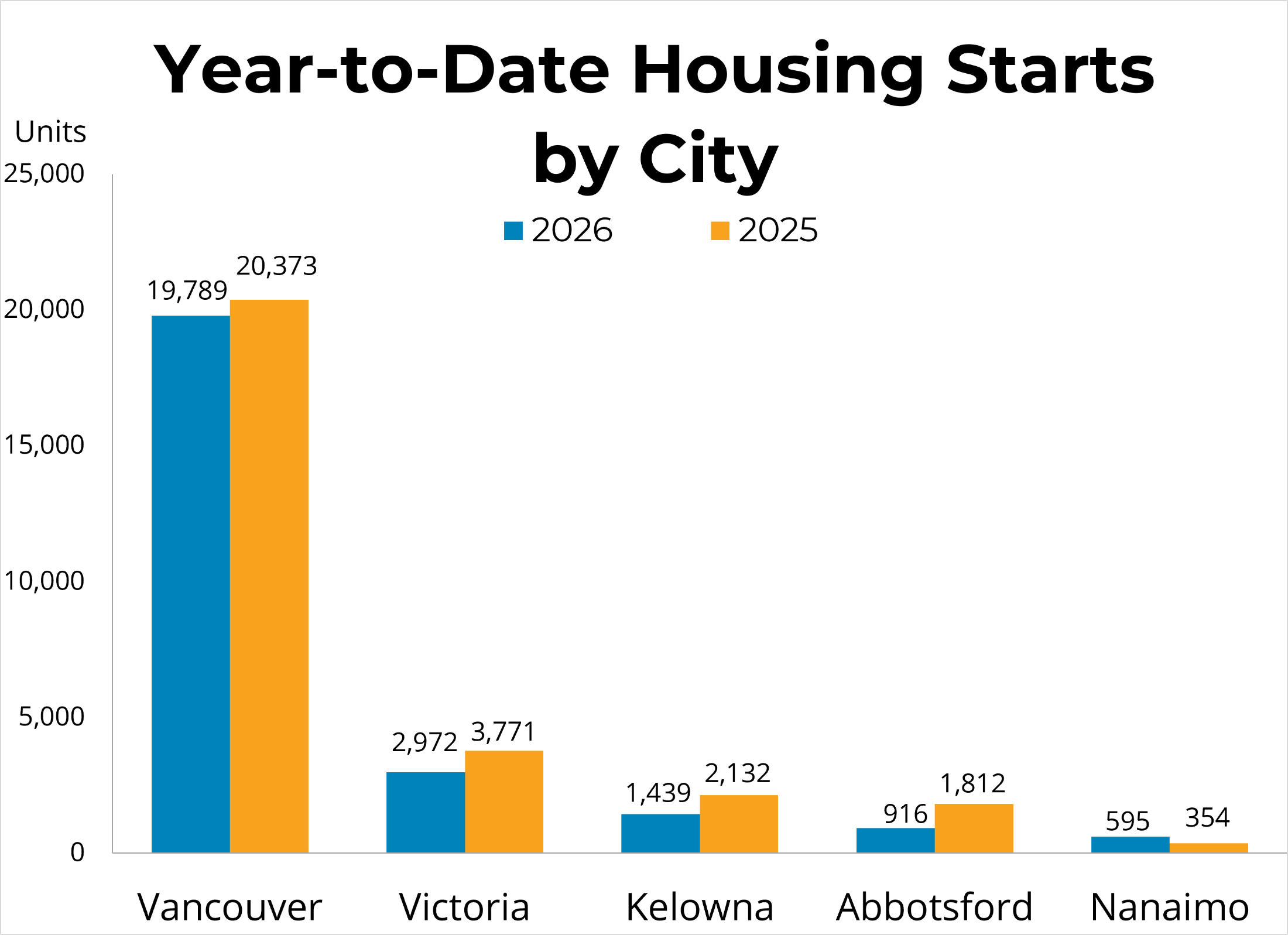
Canadian housing starts in September rose by 3 per cent from the previous month, totaling 248,896 units at a seasonally adjusted annual rate (SAAR). Starts were down 11 per cent from the same month last year (SAAR). In areas with 10,000 or more residents, single-detached housing starts were down 6 per cent year-over-year, while multi-family and other starts decreased by 12 per cent compared to September 2025

In British Columbia, starts rose by 16 per cent from last month to 53,365 units (SAAR) in all areas of the province. In areas of the province with 10,000 or more residents, single-detached starts fell by 1 per cent, while multi-family starts rose by 18 per cent. Starts in the province were 43 per cent above September 2025 levels. Year-to-date starts are up 68 per cent in Nanaimo, but down 49 per cent in Abbotsford, down 32 per cent in Kelowna, down 21 per cent in Victoria, and down 3 per cent in Vancouver.

"Copyright British Columbia Real Estate Association. Reprinted with permission."

Read

A Balanced Market Creates Opportunities for Buyers and Sellers

Real estate markets naturally move through cycles, and current conditions in many British Columbia communities are showing signs of a more balanced market compared to the highly competitive conditions experienced in recent years.

Balanced markets can create advantages for both buyers and sellers by allowing more time for informed decisions and providing a wider range of housing choices.

More Choice for Buyers

Inventory levels have increased in many parts of British Columbia and across Canada, giving buyers more options than were available during the low-inventory period of 2021 and 2022. Additional selection allows purchasers to compare properties, conduct due diligence, and make decisions that fit their long-term needs.

Opportunities for Sellers

While buyers have more choice, well-priced homes that show well and meet market expectations continue to attract interest. In balanced markets, accurate pricing and effective marketing become increasingly important.

Historically, balanced conditions often support steady market activity because buyers and sellers can negotiate with greater confidence.

Economic Factors Supporting Stability

Several economic factors continue to influence housing markets:

  • The Bank of Canada’s policy rate remains significantly lower than peak levels seen in previous years.

  • Inflation has moderated compared with earlier periods.

  • CREA forecasts modest national price changes over the coming year.

  • BCREA anticipates that sales activity in BC may improve as economic uncertainty decreases.

Looking Beyond Headlines

Housing markets are local. Conditions in individual communities can differ significantly from provincial or national trends. Buyers and sellers benefit from reviewing current local statistics, inventory levels, and recent sales activity when making decisions.

Balanced markets can provide a positive environment because they often encourage thoughtful decisions rather than rushed ones.

The Bottom Line

Current market conditions are creating opportunities for both buyers and sellers. Increased choice, stable pricing in many regions, and improving affordability conditions may help support real estate activity as markets continue to adjust.

This article is provided for general information purposes only and does not constitute financial, legal, or investment advice.

Read

Buying a Condo in British Columbia: What Every Buyer Should Know

Condominiums continue to be an attractive option for many buyers in British Columbia. Whether you are purchasing your first home, downsizing, investing, or looking for a lower-maintenance lifestyle, a condo can offer affordability, convenience, and access to amenities that may not be available with detached homes.

However, buying a strata property involves additional considerations that differ from purchasing a single-family home. Taking time to understand how strata ownership works can help buyers make informed decisions.

Understanding Strata Ownership

When purchasing a condominium, buyers own their individual unit while sharing ownership of common property such as hallways, roofs, elevators, parking areas, and amenities. The strata corporation is responsible for managing and maintaining these shared areas.

Monthly strata fees contribute toward operating costs, insurance, maintenance, and contributions to the contingency reserve fund.

Important Documents to Review

One of the most important steps in purchasing a condo is reviewing strata documents. Buyers should consider:

  • Strata meeting minutes

  • Financial statements

  • Contingency reserve fund balances

  • Depreciation reports (if available)

  • Bylaws and rules

  • Current insurance information

  • Any planned special levies

These documents can provide insight into the building’s financial health, maintenance plans, and community regulations.

Lifestyle Considerations

Every strata community is unique. Buyers should determine whether a building’s rules align with their lifestyle, including:

  • Pet restrictions

  • Rental policies

  • Age restrictions

  • Short-term rental rules

  • Parking and storage availability

Understanding these details before purchasing can help avoid surprises later.

Current Market Conditions

Across Canada and British Columbia, inventory levels have improved in many markets, giving buyers more options and additional time for due diligence compared to recent years. CREA forecasts modest national price growth through 2026, while BCREA expects relatively stable pricing in many BC markets. More balanced conditions can provide opportunities for buyers to compare properties carefully and make informed decisions. 

The Bottom Line

A condominium can provide an excellent housing option, but buyers benefit from understanding both the property itself and the strata corporation that manages it. Careful review of documents, financial information, and building rules can help ensure a purchase aligns with both financial goals and lifestyle preferences.

This article is for general information purposes only and is not intended to provide legal, accounting, or financial advice. Buyers should seek advice from qualified professionals where appropriate.

Read

Home Sales Expected to Rise in 2027

The British Columbia Real Estate Association (BCREA) released its 2026 Third Quarter Housing Forecast Update today.

Multiple Listing Service® (MLS®) residential sales in BC are forecast to fall 1.2 per cent to 69,325 units this year. In 2027, MLS® residential sales are forecast to move higher, rising 7.5 per cent to 74,500 units.

“A long-awaited recovery in the British Columbia housing market appears to be underway as we enter the second half of 2026, but will be slow and gradual and continues to be challenged by persistent geopolitical volatility,” said BCREA Chief Economist Brendon Ogmundson. “Ultimately, an expected pick-up in the provincial economy over the next year provides cause for optimism that sales activity will improve in 2027.”

With active listings near their highest level since 2015, and additional pressure from elevated new-home inventory, we anticipate the average price in BC will fall by 1.2 per cent in 2026 to $941,800, down from $952,767 in 2025. This decrease largely reflects disproportionate weakness in more expensive markets in the Lower Mainland, casting downward pressure on the broader provincial average price. 

"Copyright British Columbia Real Estate Association. Reprinted with permission."

Read

The British Columbia Real Estate Association (BCREA) reports that 7,225 residential unit sales were recorded in Multiple Listing Service® (MLS®) Systems in June 2026, up 0.9 per cent from June 2025. The average MLS® residential price in BC in June 2026 was down 0.8 per cent at $946,878 compared to $954,712 in June 2025.

Total MLS® residential sales dollar volume was $6.84 billion, up 0.1 per cent from the same time the previous year. BC MLS® unit sales were 18.4 per cent lower than the ten-year average for the month of June.

“Sales rose year-over-year in June for the first time since September 2025, driven by stronger activity in the Greater Vancouver area,” said BCREA Chief Economist Brendon Ogmundson. “We hope this marks the beginning of a stronger second half of the year across BC housing markets as sales converge to more normal levels following several years of unexpected global shocks.”

Year-to-date, BC residential sales dollar volume is down 6.4 per cent to $31.96 billion, compared with the same period in 2025. Residential unit sales are down 5.4 per cent year-over-year at 33,886 units, while the average MLS® residential price is also down 1.1 per cent to $943,249.

"Copyright British Columbia Real Estate Association. Reprinted with permission." BCREA makes no guarantees as to the accuracy or completeness of this information.

Read

Bank of Canada Interest Rate Announcement – July 15, 2026

The Bank of Canada held its overnight policy rate at 2.25 per cent this morning. In the statement accompanying the decision, the Bank noted that despite significant global uncertainty and volatility, Canada's economy is showing signs of improvement, with growth rebounding in the second quarter and broadening across sectors. The Bank projects growth of just 0.7 per cent this year but expects the economy to expand by 1.8 per cent in both 2027 and 2028. On inflation, the Bank expects CPI to remain elevated in June before gradually easing in the coming months and returning to its 2 per cent target in 2027.

Although the status of the conflict with Iran remains fluid, fears of an oil-price-driven inflation spiral have not materialized. While headline inflation has moved higher, there is little evidence that higher energy costs have been passed through to core inflation in Canada, which remains subdued. As such, there is no need for the Bank to raise rates this year. However, if the Canadian economy continues to regain momentum and core inflation settles near the Bank's 2 per cent target, policymakers may not need to keep the overnight rate at the low end of the neutral range for much longer. In that case, the Bank could begin moving its policy rate back toward 2.75 per cent next year.

That outlook, combined with rising inflation in the United States, which has made a summer rate hike by the Federal Reserve a real possibility, is putting upward pressure on five-year bond yields, which drive fixed mortgage rates in Canada. Consequently, fixed mortgage rates may edge higher heading into the fall.

"Copyright British Columbia Real Estate Association. Reprinted with permission." BCREA makes no guarantees as to the accuracy or completeness of this information.

Read

From Offer to Possession

Understanding the Key Dates in a B.C. Contract of Purchase and Sale

While the purchase price often gets the most attention, the various dates contained within the contract are equally important because they establish the timeline for the transaction and outline the responsibilities of both the buyer and seller.

Understanding what these dates mean can help reduce confusion and ensure a smoother transaction.

Date of Offer

The date of the offer is simply the day the buyer signs and submits their offer to purchase the property. This date establishes when the offer was made. In British Columbia, a verbal offer is not binding in a real estate transaction.

For an offer to be valid and enforceable, it must be made in writing.

Offer Open for Acceptance

Every offer includes a deadline by which the seller must respond. This is date and time that an "Offer Open for Acceptance". If the seller accepts the offer before this deadline and the acceptance is properly communicated, a contract is formed. If the deadline passes without acceptance, the offer expires automatically.

This deadline helps ensure that buyers are not left waiting indefinitely for a response.

Acceptance Date

The acceptance date is the date on which the seller accepts the buyer's offer and the acceptance is communicated to the buyer or the buyer's representative. Once acceptance has occurred, a legally binding contract is generally created, subject to any conditions contained within the agreement and any applicable statutory rights, such as the Home Buyer Rescission Period.

Buyer's Right of Rescission

In British Columbia, most residential home purchases are subject to the Home Buyer Rescission Period (HBRP), sometimes referred to as the "cooling-off period." The HBRP generally gives a buyer the right to cancel an accepted offer within three business days following acceptance of the contract. If a buyer exercises this right, they must pay the seller a rescission fee equal to 0.25% of the purchase price. 

Not all transactions are subject to the HBRP, and there are exemptions established by legislation. Buyers should seek professional advice if they are unsure whether the rescission period applies to their purchase.

Deposit Date

The deposit is a sum of money provided by the buyer as specified in the contract. The contract will identify both the amount of the deposit and the deadline by which it must be delivered. Deposits are typically held in trust by the brokerage unless otherwise specified.

The deposit forms part of the purchase price upon completion of the sale. If a transaction fails to complete, the handling of the deposit will depend on the terms of the contract and any agreement between the parties or legal determination.

Subject Removal Date

Many offers contain conditions, commonly known as "subjects," that must be satisfied or waived before the transaction becomes firm.

Common subjects may include:

  • Financing approval

  • Property inspection

  • Review of title or disclosure documents

  • Sale of the buyer's existing property

The subject removal date is the deadline by which the buyer must either remove or waive these conditions in writing. If the subjects are not removed by the specified deadline, the contract may come to an end unless the parties agree otherwise.

Completion Date

The completion date is the day legal ownership of the property transfers from the seller to the buyer.

On this date:

  • The buyer's lawyer or notary transfers the purchase funds.

  • Transfer documents are registered with the provincial land title system.

  • The seller receives the sale proceeds after adjustments and closing costs.

Completion usually occurs during regular business hours and is often not the same day that the buyer receives the keys.

Adjustment Date

The adjustment date is the date used to calculate financial adjustments between the buyer and seller.

These adjustments may include:

  • Property taxes

  • Utility charges (where applicable)

  • Rental income deposits

  • Other prepaid or outstanding expenses related to the property

The goal is to ensure that each party pays only their fair share of expenses for the period during which they own the property. In most residential transactions, the adjustment date is the same as the completion date, although it can differ if the parties agree.

Possession Date

The possession date is the day the buyer receives the right to occupy the property and typically receives the keys.

Possession often occurs the day after completion, although the parties may agree to a different arrangement.

Buyers should avoid scheduling movers, contractors, or other services until possession has been confirmed through their lawyer, notary, or real estate professional.

Property Viewed Date

The contract includes a section where the buyer indicates the date on which they viewed the property.

This date records when the buyer physically viewed the property or acknowledges that the property may not have been viewed before the offer was made. The property viewed section helps document the circumstances surrounding the purchase and forms part of the contract record.

An important provision connected to this section states that the property and all included items will be in substantially the same condition on the Possession Date as when viewed by the buyer, subject to reasonable wear and tear and any changes agreed to by the parties in writing.

This provision helps establish the expectation that the buyer will receive the property in essentially the same condition as it was when they decided to purchase it. For this reason, buyers will often conduct a final walk-through before completion or possession to confirm the property's condition and verify that any agreed-upon inclusions remain in place.

Why These Dates Matter

Every date in a Contract of Purchase and Sale serves a specific purpose. Missing a deadline can have significant consequences, including the loss of contractual rights, delays in closing, or even the termination of a transaction.

Whether you're buying your first home or selling a property you've owned for years, understanding the timeline established by the contract can help you make informed decisions and avoid unnecessary surprises.

Final Thoughts

A Contract of Purchase and Sale is more than just a purchase price and a signature. It is a detailed roadmap that guides the transaction from the initial offer through to possession of the property.

If you are buying or selling real estate in British Columbia, take the time to review each date carefully and ensure you understand its purpose. When questions arise, seek advice from qualified professionals, including your real estate licensee, lawyer, or notary, so that you can proceed with confidence.

This article is intended for general information only and is not legal advice. Real estate transactions can vary, and readers should seek professional advice regarding their specific circumstances.

Read
The trademarks REALTOR®, REALTORS®, and the REALTOR® logo are controlled by The Canadian Real Estate Association (CREA) and identify real estate professionals who are member’s of CREA. The trademarks MLS®, Multiple Listing Service® and the associated logos are owned by CREA and identify the quality of services provided by real estate professionals who are members of CREA. Used under license.
Powered by: REALTOR.ca